

case study
minishell
A Unix shell implementation in C covering parsing, expansion, redirections, pipelines, processes, signals, and memory management.
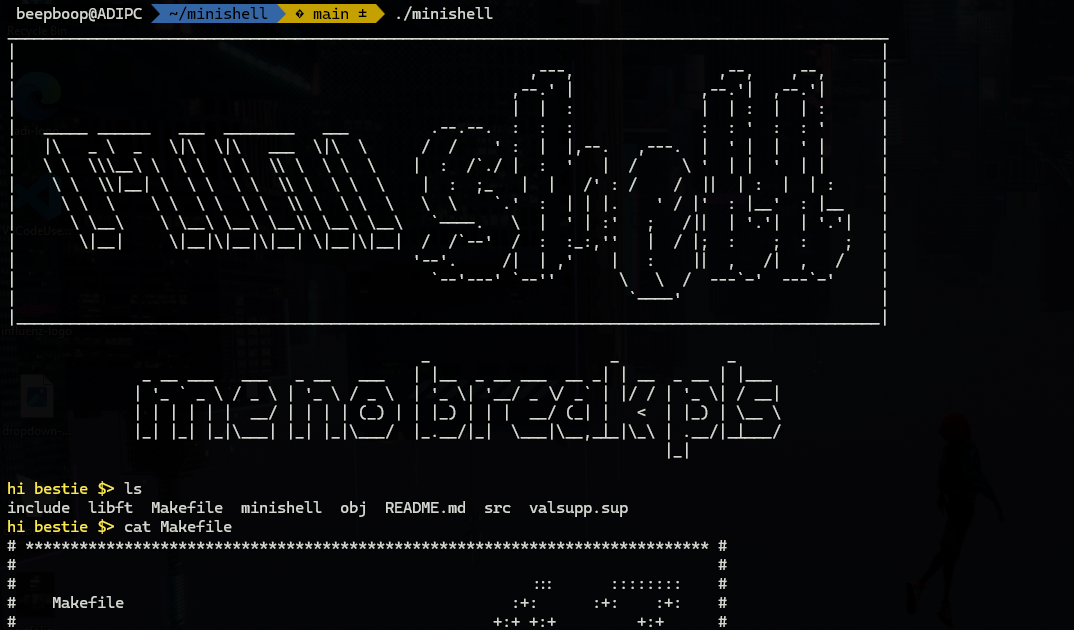
overview
A low-level systems project that rebuilds core shell behaviour instead of delegating process execution and parsing to a high-level runtime. The code is split into parsing, expansion, execution, built-ins, redirection, signal handling, and cleanup responsibilities.
architecture
User input → syntax validation → parsing/tokenisation → quote handling and expansion → redirections/pipelines → command lookup/execution → process and signal management.
engineering focus
- Unix process creation and process control.
- File descriptors, pipes, redirections, and signal semantics.
- Memory ownership, cleanup across execution paths, and low-level debugging.
- Building a non-trivial command interpreter without relying on a high-level process runner.
highlights
- Command execution through PATH plus built-ins including echo, cd, pwd, export, unset, env, and exit.
- Pipes, input/output redirections, environment expansion, quoting, syntax validation, and signal handling.
- Separate components for parsing, expansion, execution, built-ins, redirections, signals, and memory cleanup.
- Valgrind tooling for leak checking and file-descriptor tracking.
project context
Built as part of the 42 Abu Dhabi curriculum.
project media
Existing portfolio media